
Black Flag Resynced Is How You Do a Remake Right
My mission log says 54 percent of the main story complete, and it has been stuck near that number for a week. I know exactly why. Every time I point the Jackdaw at the next story marker, something else shows up on the horizon. Methodology note: the surviving notes preserve that completion figure and the observations below, but not the exact platform, build, hours, or access provenance. This is a progress review, not a final verdict or controlled performance test.
For anyone who skipped the reveal: this is Ubisoft's full remake of the 2013 fan favorite, rebuilt on the current version of the Anvil engine, the same tech behind Valhalla, Mirage and Shadows. Not a remaster with sharper textures. Every asset was redone, weather is dynamic, and objects break when cannonballs disagree with them. Thirteen years of engine work separate this from the original, and you feel every one of them.
Thirteen Years Newer
The water sold me first. I know, every sea game gets that compliment, but the Caribbean here changes color with the hour and the weather in ways I have not seen elsewhere. One night I sailed into a storm and could barely make out the bowsprit; the next morning the same stretch of sea turned a turquoise so loud I stopped steering just to look at it. Character models and facial animation received equal care, and the underwater sections rival most modern games that attempt them.
The official launch overview lists three console choices rather than two: a 60 fps performance mode, a 30 fps quality mode, and a 40 fps balanced mode for compatible displays. I stayed with performance in my sessions. Loads commonly felt like five to eight seconds in that configuration, but I did not capture frame-time or storage measurements.
The Sea Keeps Stealing the Show
Out on the open water the remake shows off constantly without ever announcing it. Drop the sails and the crew starts singing, and Ubisoft chose not to translate the shanties in localized versions, which makes them sound like an actual working crew. My Jackdaw is black and gold thanks to the Deluxe edition cosmetics. A ship's cat naps beside the helm. Somewhere between two islands a whale breached off my port side, and I realized I had not touched fast travel in hours.
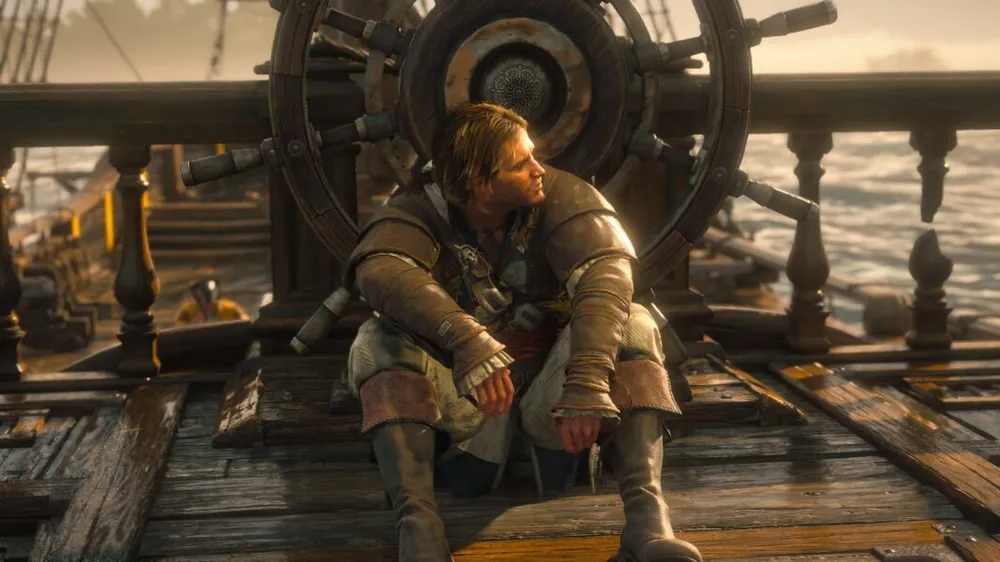
Exploration is where entire evenings vanish. Forts can be assaulted and claimed if your ship survives the attempt, and claiming them is always worth the powder. Treasure maps mark a latitude and longitude, and when you land on an island holding one of your maps, the game quietly nudges you toward the dig spot. Mayan stelae puzzles ask you to line carvings up against the landscape. A fleet mini-game turns captured ships into workers you send off on missions of their own. I meant to spend last Saturday pushing the story forward. I mean... I tried. I recorded a play session and checked the clip afterwards: thirty-four minutes, and not one story mission in it.
Combat That Finally Aged Well
Combat received the biggest mechanical overhaul. Ubisoft's combat and parkour deep dive documents parries, perfect parries, chain takedowns, movement changes, and the Hidden Blade's revised combat role. In play, those systems made brawls feel like a buildup toward an execution rather than a repetition of the 2013 counter loop.
Stealth was modernized with the light and darkness systems from recent entries, and I will admit something: I have never liked stealth in games. Resynced does not punish me for it. Edward is a pirate before he is anything else, so when a guard spots me and I answer with two swords, the game treats that as a legitimate plan rather than a failure state. You can even wear the hood up or down freely, since it changes nothing about detection. Movement improved alongside it: a manual jump joined the parkour, you can redirect mid-air instead of being locked into an animation, and ziplines were added so naturally that I had to check whether the original had them. It did not.
The Jackdaw Grew Teeth
Ship-to-ship combat was already the best part of the original, and it picked up real depth here. Ubisoft's naval deep dive details alternate ammunition, manual swivel aiming, and boarding outcomes. Swapping firing types mid-battle made the Jackdaw feel less like one upgrade meter and more like a tool kit.
The economy holds the whole loop together. I was sitting on roughly 28,000 reales and it felt like pocket change because ship and hideout upgrades competed for the same resources. The remake adds three recruitable Naval Officers: Lucy Baldwin, Padre, and Tobias 'Deadman' Smith. I had recruited Lucy when these notes were taken; an earlier version incorrectly described the other two only by job titles.
What Resynced Actually Adds
The boldest change is replacing the original playable Abstergo office subplot with Rifts, four what-if scenarios that open across the campaign. Calling every modern-day element gone would be too broad because Animus framing and related records remain. Ubisoft's expansion deep dive explains how the new scenarios and post-game material fit around Edward's story.
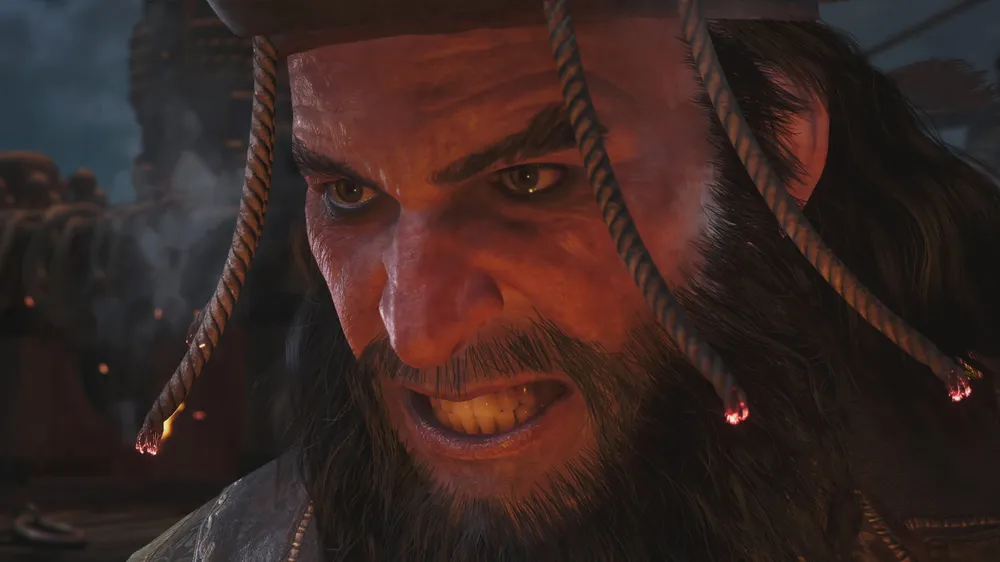
The endgame got the most generous addition. A World Without Gold is a new Blackbeard-focused chapter with eight missions, plus treasure quests and a post-game story about Stede Bonnet, the talkative merchant from the opening hours. Ubisoft brought the original cast back for the new material, Matt Ryan included, and recorded fresh motion capture, so nothing about these scenes feels bolted on. Edward Kenway sits in this franchise's top tier of protagonists, right beside Ezio.
Where It Stumbles
Not everything lands. The Animus Hub greets you at every boot, the shared hub that debuted with Shadows, complete with Projects, Exchange and Synchronization rewards, and only after passing through it do you reach Black Flag itself. Maybe it becomes something worthwhile. Today it is one more screen between me and my ship. Diving in the open ocean also promises more than it delivers: away from islands, the water is blue in every direction and nothing else. And the game is noticeably prettier by day than by night, though the new ability to speed up the time of day, one of several quality-of-life additions, at least lets me schedule my sunsets.
The Verdict From Halfway
Remakes are doing heavy rotation on the release calendar, with Capcom's Code Veronica remake still ahead of us, and most settle for playing it safe. This one rebuilt a thirteen-year-old classic from the keel up, cut the subplot nobody missed, added stories worth playing and left the soul of the thing untouched. I keep telling friends what I have said for years: as a single-player pirate adventure, nothing else comes close. That was true in 2013, and this remake makes it true all over again. Now, if you will excuse me, my log still reads 54 percent and there is a fort on the horizon that thinks it can hold me off.

Related posts

007 First Light Review: The Best Bond Game in Years
IO Interactive blends Hitman-style stealth with cinematic action to tell an original young-Bond origin story. A few rough edges aside, 007 First Light is the most exciting 007 game in years.

Indiana Jones and the Great Circle Understands Adventure Needs Quiet Spaces
An analytical look at how first-person exploration, puzzles, and improvised tools can turn familiar mechanics into choices players can understand and remember.
Split Fiction Shows Co-Op Works When Players Need Different Things
An analytical look at how two writers, split abilities, and asymmetric co-op can turn familiar mechanics into choices players can understand and remember.
DOOM: The Dark Ages Makes a Power Fantasy Stronger With Limits
An analytical look at how the Slayer Shield, parries, and deliberate aggression can turn familiar mechanics into choices players can understand and remember.