
Mortal Kombat II Finally Stops Apologizing for Mortal Kombat
Editor's note, July 29, 2026: this article was originally labeled a review even though its screening conditions were not recorded. It has been rewritten as an editorial analysis based on official material, and undocumented claims about the author's viewing experience have been removed.
The strongest thing about director Simon McQuoid's sequel is visible before any critical verdict: it stops apologizing for the source material. The official Warner Bros. synopsis describes Johnny Cage joining Earthrealm's champions in a no-holds-barred, gory battle against Shao Kahn. That is the language of the games rather than a prestige-film disguise. Mortal Kombat has portals, resurrected warriors, four-armed emperors, and fatalities designed to make a room shout. An adaptation gains nothing by acting embarrassed about the material it chose.
A bigger, bloodier swing
The setup is refreshingly simple. Johnny Cage joins Earthrealm's defenders against Shao Kahn, whose rule threatens their world. The official site also confirms that Simon McQuoid returned after directing the 2021 film, with Jeremy Slater writing the screenplay and Ed Boon and John Tobias credited for the game on which it is based. That framing gives the sequel room to make the tournament the structure instead of another promise waiting beyond the credits. A fighting-game film should understand that rivalries and bouts are not interruptions to the plot. They are how this particular world reveals character.
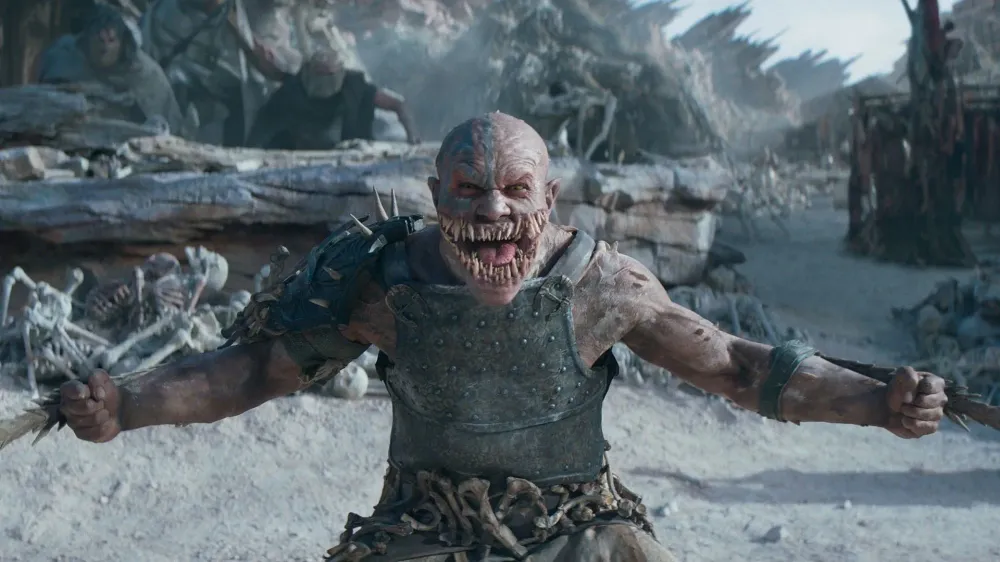
The promotional campaign lays the fan service on thick, and that is an honest contract with the intended audience. Baraka, the fanged Tarkatan introduced in the 1993 arcade sequel that gives this film its name, is not a piece of lore the adaptation needs to translate into something respectable. His silhouette, blades, and place in the roster already communicate the point. The useful kind of fan service brings a game's visual and mechanical identity into another medium. It becomes empty only when recognition replaces a dramatic function.
Karl Urban's Johnny Cage steals the show
The sequel's clearest structural advantage is handing a central role to Johnny Cage. Warner's cast list confirms Karl Urban as Cage alongside Adeline Rudolph, Jessica McNamee, Josh Lawson, Ludi Lin, Mehcad Brooks, and the returning ensemble. Cage is useful because his vanity provides a human scale for the nonsense. He is an action star entering a world in which the effects are real, the monsters do not wait for a stunt coordinator, and celebrity offers no protection. The character can laugh at the premise without teaching the audience to dismiss it.
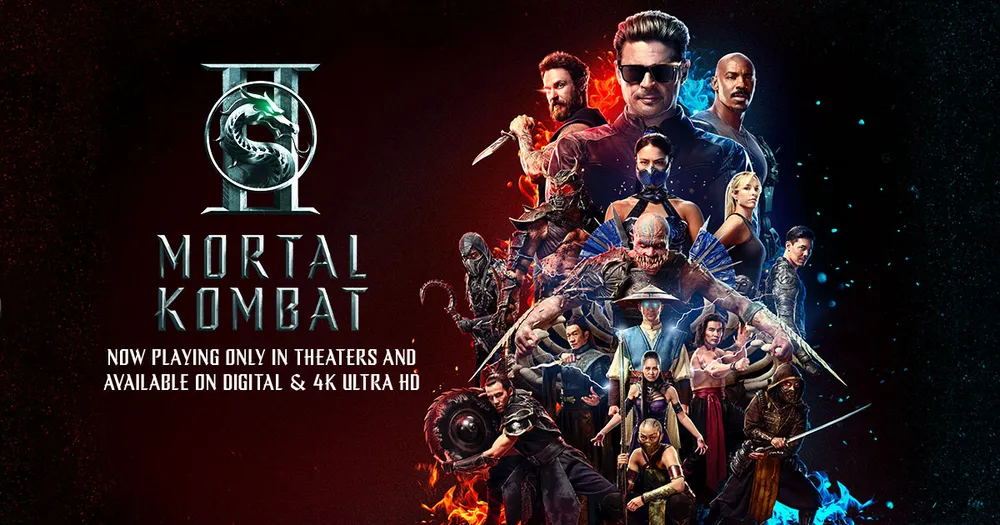
Josh Lawson's return as Kano creates a second route into the comedy. The danger is relying on self-awareness so heavily that every sincere moment gets punctured before it can land. Mortal Kombat is ridiculous, but its rivalries still need conviction. Cage and Kano can acknowledge the absurdity from different angles while Liu Kang, Jax Briggs, Sonya Blade, and the rest of the ensemble treat the stakes as real. That tension is more useful than making every character compete for the same one-liner.
Why the tournament structure matters
A tournament gives this ensemble a clean reason to meet, clash, separate, and return. More importantly, it creates visible progress. Fighting games make advancement legible through brackets, rivalries, and increasingly dangerous opponents. Film adaptations often replace that clarity with a quest for artifacts or a threat that remains abstract until the final act. Mortal Kombat does not need another elaborate excuse for Sub-Zero and Scorpion to occupy the same arena. It needs each confrontation to change what the audience understands about the people involved.
The cracks in the armor
The premise also carries obvious risks. Warner's official cast list is enormous, and a tournament can become a roll call if the screenplay treats every familiar face as an obligation. A few characters need enough space for a defeat to matter. Mortal Kombat also has an eternal problem with stakes: death is reversible across the games, so a film cannot depend on gore alone to create consequence. Relationships, loyalties, and changes in power have to survive even when a fallen fighter can return for another round.
That recycling is faithful to a series built on bringing defeated fighters back for one more round. Faithfulness does not automatically make it dramatically satisfying. The adaptation needs to decide which consequences remain permanent even when bodies do not. A rivalry can be resolved, trust can be broken, and a realm can be altered without pretending every fatality closes a character's history forever.
The case for direct adaptation
Mortal Kombat II makes a stronger case for itself when it treats directness as a feature. The tournament, Urban's Johnny Cage, Shao Kahn, and deliberately excessive violence tell audiences exactly which adaptation they are being offered. That clarity cannot guarantee good pacing, convincing effects, or enough room for a crowded cast. It does establish the right creative priority. A Mortal Kombat movie should first work out why people care about these fighters, then use cinema to stage that affection with movement, performance, and scale. It should never spend the opening act asking permission to be Mortal Kombat.

Related posts

The Super Mario Galaxy Movie Crosses $1 Billion Worldwide
Illumination's sequel has become the first film of 2026 to pass $1 billion at the global box office, and it pushed the Super Mario franchise past Madagascar in the process.
Indiana Jones and the Great Circle Understands Adventure Needs Quiet Spaces
An analytical look at how first-person exploration, puzzles, and improvised tools can turn familiar mechanics into choices players can understand and remember.
Split Fiction Shows Co-Op Works When Players Need Different Things
An analytical look at how two writers, split abilities, and asymmetric co-op can turn familiar mechanics into choices players can understand and remember.
DOOM: The Dark Ages Makes a Power Fantasy Stronger With Limits
An analytical look at how the Slayer Shield, parries, and deliberate aggression can turn familiar mechanics into choices players can understand and remember.