
Elden Ring Nightreign at One Year: Loved, but Left Behind
Exactly one year ago today, Elden Ring Nightreign arrived and asked a strange question: what happens when you take FromSoftware's most celebrated world and bend it into a fast, co-op, rogue-like survival run? Bandai Namco's official game page dates the release to May 30, 2025 and describes three-player expeditions across an ever-changing Limveld. Twelve months later, the answer is clearer than it was at launch, and a little more bittersweet. Nightreign found a dedicated audience. But on the morning of its first anniversary, there is still no announced year-two roadmap.
Nightreign was never going to be Elden Ring, and any honest look at its first year has to start there. The 2022 original was a once-in-a-generation phenomenon, a game that burst clean out of the soulslike bubble and dragged an entire subgenre toward the mainstream. Nightreign never performed that miracle, and it was never really built to. What it did instead was something quieter but no less impressive: it was embraced, warmly, inside the bubble it came from, and a year on it still posts numbers that stand comfortably alongside Elden Ring itself. For a spin-off experiment, that is a genuine success story.
A launch that found its crowd
Nightreign shipped lean and focused: eight playable characters, each with their own kit and rhythm, and eight final bosses waiting at the end of a run. That was the whole package, and at first some players wondered whether it was enough. It turned out to be plenty, because the loop underneath was so strong. Three-player expeditions across a collapsing map, racing the clock and the encroaching night, gave the formula a tension that rewarded coordination and punished hesitation. The community took to it fast, and the chatter never really died down.
Those kits also did something no FromSoftware game had managed with me before: they talked me into playing a mage. I am, by long and stubborn habit, a pure-strength brute, the Giantdad school of heavy poise and a big dumb sword, and I usually leave sorcery to other people. The Recluse broke that. She fights by pulling the elemental residue your party smears across an enemy and stitching it into a spell on the spot, fire and lightning and magic braided together mid-brawl rather than picked off a menu beforehand. Plenty of games let you cast elements. Almost none let you combine them live like that, and fewer still make the act feel this satisfying. I went from ignoring the sorcery slot entirely to maining it.
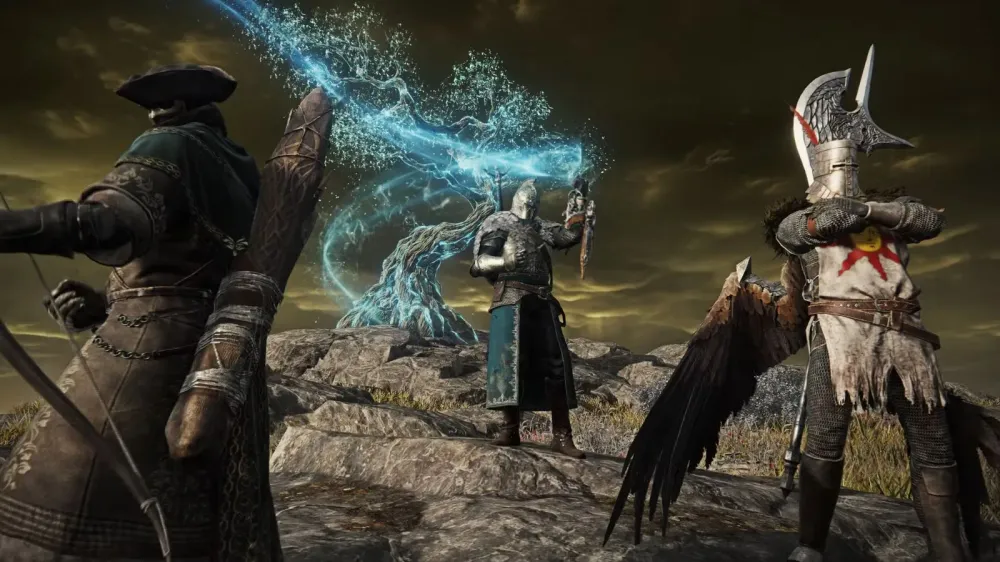
Part of what kept people invested was how clearly the game loved its own lineage. Cosmetics and alternate visuals leaned into FromSoftware's broader catalog, with several outfits openly paying homage to the Dark Souls trilogy. These were not just skins; they were little gifts to the people most likely to be playing dozens of hours a week, the kind of detail that turns a player base into a community.
A year of updates
FromSoftware did not leave the game static after launch. Just weeks in, it introduced what quickly became the standout post-release idea: the Everdark Sovereigns. Bandai Namco's official announcement documents the weekly rotation, eligibility rules, new moves, increased power, and Sovereign Sigil rewards. It was a clever, low-friction way to keep the endgame fresh without bloating the roster. The cadence gave the community a shared ritual and a moving target around which to compare strategies.
That momentum set the stage for the big one. After months of weekly sovereign rotations, FromSoftware announced the game's first proper DLC: the expansion players had been hoping would push Nightreign into its next era.
The DLC: new content, old frustrations
On paper, The Forsaken Hollows delivered the right categories of content. The official DLC overview confirms two additional Nightfarers, two new bosses, and one new Shifting Earth environment. For a game built on rogue-like replay, more variety in what a run can throw at a group is exactly the right kind of addition. The expansion gave the expedition cycle more combinations without pretending to become a second base game.
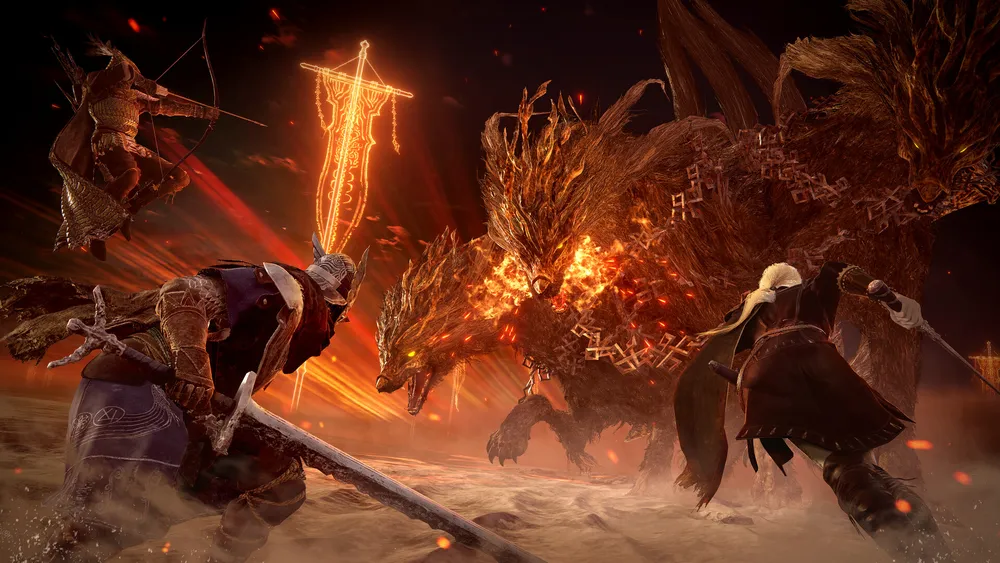
It was not a clean victory, though. The expansion arrived with real controversy, and the loudest complaint was about what it didn't include: new weapons. The community had been asking for fresh armaments for ages, and their absence stung. The new map drew criticism of its own, too. Its sharply vertical design makes early navigation genuinely frustrating, and the brutally limited time a run gives you leaves little room to learn its layout before the clock turns against you. The standout central crystal and its unique power-up are a great hook, but getting to it the first few times feels more like fighting the geometry than the enemies.
Then, silence
And that, more or less, is where the public roadmap stops. Bandai Namco's official Nightreign news index records continued fixes through March 2026, but no announced second expansion or year-two content plan by the date of this article. That distinction matters: maintenance is real support, while a future content commitment is something the publisher has not made. The quiet is conspicuous on an anniversary that should feel celebratory.
Still, there's hope
Soulslikes are the well I keep coming back to, the genre I'll go to bat for even when it stumbles, so maybe I'm biased here. I'm not ready to write it off. FromSoftware is still actively supporting Elden Ring, with new content on the way via the upcoming Tarnished Edition despite the base game now being several years old, proof that the studio will keep tending a title long after most publishers would have moved on. Nightreign, for better or worse, has shown it has serious potential as a live-service project if FromSoftware ever decides to fully commit to it. The bones are there. The audience is there. One year in, the game is loved. It just deserves to feel a little less left behind. Here's hoping year two gives the Nightfarers something new to chase.

Related posts

Monster Hunter Wilds Needs a Hunt to Be More Than a DPS Check
Monster Hunter Wilds is at its best when tracking, weather, preparation, and teamwork change a hunt before the damage race begins.
Beast of Reincarnation Is the Reinvention Game Freak Needed
Game Freak's new action RPG is valuable because it cannot be mistaken for Pokémon. A different scale, tone, and combat language can reveal strengths hidden by one defining franchise.
The Blood of Dawnwalker Is Right to Put the Game Before the Sales Target
Rebel Wolves says sales are secondary to making the RPG it believes in. That creative priority is healthy, provided ambition is matched by disciplined scope and honest production.

Rise of the Ronin Shows the Best Thing a Subscription Can Do
Subscription catalogs are at their best when they create a second launch for a game that was easy to overlook. Rise of the Ronin is a better argument for PS Plus than another day-one content race.